
Inkpot Magazine
My Valentina
Inna V. Lyon
Fall 2026
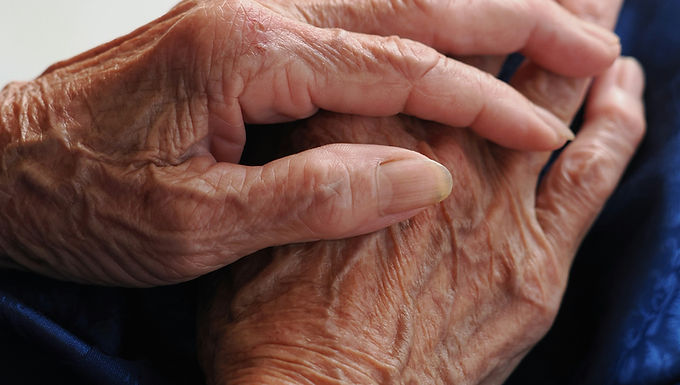
A close-up of an elderly person's hands
My Aunt Valentina was not expected to live long.
She suffered from meningitis at seven. Tuberculosis at ten. Thrombophlebitis at twenty-three. And kidney failure at thirty-five.
At twenty-five, when the tuberculosis came back, my aunt—until recently a plump little dumpling of a woman—resembled the gaunt Komsomol girl statue that stood in October Square in Taganrog, Russia: the same short haircut and large, shining, sickly eyes.
Despite every doctor’s prophecy, she lived. No—she didn’t just live. She lived.
She lived at full throttle, pedal pressed to the floor, with her heart thrown open wider than the gates of the city park. She loved everything alive, blooming, lofty, and spiritual.
She lived by working as a nurse and giving her hours and her heart to her patients with that same terrible tuberculosis, which turned from a mortal threat into a lifelong companion.
She lived by sewing dresses and outfits for herself and her daughter, her husband, the neighbors, friends, friends of friends, and tenth cousins twice removed.
She lived by writing poems and short essays—touching and piercing, as an answer to the pain and suffering of others.
She lived by traveling wherever her restless, adventure-hungry spirit would take her.
She lived by answering every call, every request, every plea—medical, financial, mundane, or life-changing.
The doors to her ordinary two-room apartment were always open. Over the years, that small home had sheltered her friend Katya and her newborn baby, the Glukhov family during their endless home renovation, her grand-nephew Vanya as he saved for his studies, and me—a niece left adrift by my parents’ divorce. I moved into her home and became the second daughter to her and her husband. She found me a job in the cafeteria of the tuberculosis sanatorium where she worked as a nurse. She taught me how to sew, to set a beautiful table, to write poems, and most importantly, I inherited her gift by opening my own heart in response to others’ troubles. I tried on her clothes and dreamed of growing up to be just like her.
Every morning she would step out of the building in tall, imported clogs, a pleated skirt, or a new dress sewn overnight, with perfect makeup and a light dandelion-puff perm. Babushkas, the old women at the entrance, would freeze, their daily gossip interrupted. “Decent people don’t take taxis to work, especially at ten in the morning,” they would mutter.
Yet the moment someone fell ill, the same babushkas would run to her: “Valentina, come look at Seryozha (or Peter or Zhenya) … he’s coughing (or running a fever or getting skinnier).” And Valentina would go. She gave injections, set up IV drips, taught cupping therapy, and never took a single kopeck coin in payment. She addressed everyone formally and with respect. Gradually, the babushkas began greeting her with warm smiles and small gifts of flowers, chocolate or hand-knitted socks to express their gratitude.
But one spring, something incredible happened that gave the babushkas a new topic of gossip.
That year, the popular Alla Pugacheva’s song, “A Million Scarlet Roses,” played from every window—a powerful urban legend about a million roses sacrificed in the name of love. Valentina’s husband turned the fairy tale into reality. Only instead of roses, there were tulips. One April morning he parked his KamAZ truck in front of the building, its bed overflowing with tulips of every color. Valentina stood there handing out armfuls of flowers to every neighbor, saying, “Put them in water right away—they haven’t had a drink in a while.”
Her husband brought home everything in that truck—potatoes, cabbage, watermelons, fish. But his greatest gift was his love for Valentina.
Legends were told about Valentina’s cooking. Her kitchen smelled like heaven. Meat baked in a pumpkin, cutlets in egg-and-breadcrumb batter, baked fish with vegetables and herbs, pies, cakes baked with jam, sour cream, and clouds of meringue. And her pilaf … that deserved its own story. An Uzbek friend once taught her the real recipe, and it became her signature dish. Whole heads of garlic, three kinds of raisins, specially cut carrots, and rice that was never stirred. Her tiny apartment once hosted forty guests across three tables, filled with laughter, the aroma of twenty buckets full of flowers, mingled with the heavenly scent of Valentina’s pilaf.
* * *
Valentina still writes poems and short stories. Her fingers don’t bend as easily now, but the muse still visits her every morning. Her eyes need two pairs of glasses to thread a needle, yet she continues to sew beautiful clothes, and patchwork vests that half of the town wears. She travels with her children and granddaughters and never stops marveling at the beauty of our Earth.
This year Valentina turned seventy-seven. The doctors who predicted her early death have long since passed away. Many new health complications have come and gone. The babushkas by the entrance of her building have been replaced by new ones with cell phones and social media. The KamAZ truck no longer parks in front of the building.
But she goes on living—giving, delighting, serving, and loving with an open heart.
Valentina’s legacy keeps living too: her communication skills have passed on like an inheritance to her children, her love for art and nature to her granddaughters, and (I dare to hope) her kindness and zest for life are inherited by me, her niece, finding a safe harbor in her home and heart.
I know who allowed her to live this way. Someone wise and powerful who understood that without her pies, her vests, her poems, and her caring hands, the world would be a poorer, colder, and far less compassionate place.
Live long, my dear Valentina.
Inna V. Lyon, a Russian bumpkin, was raised on a steady diet of cabbage and potatoes, along with the required reading of Chekhov and Dostoevsky. She works as an accountant and write in English and Russian. A member of the LUW, she currently serves as president of the Blue Quill Chapter. An award-winning writer in various genres and LUW Writer of the Year, Inna writes stories about life, miracles, and cats. She lives in Utah with her big, happy family. www.innalyonwriter.com